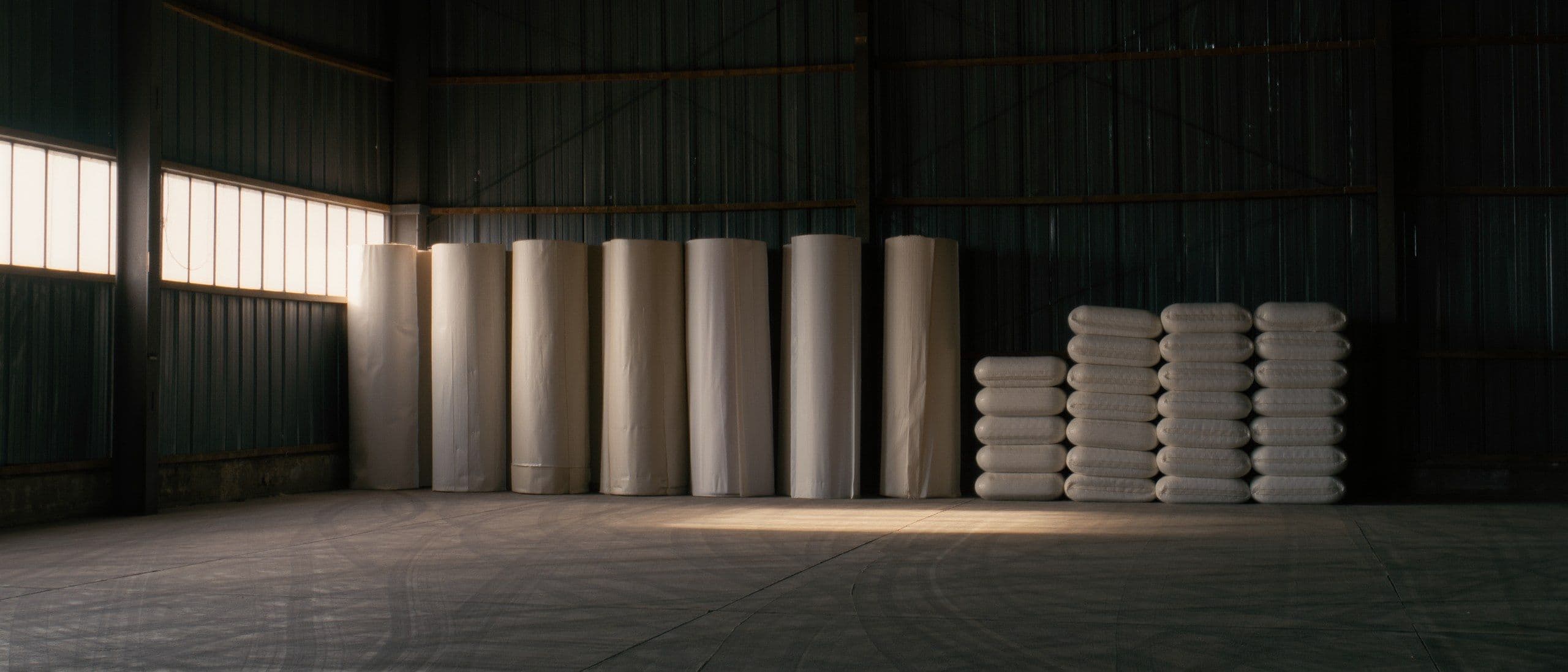
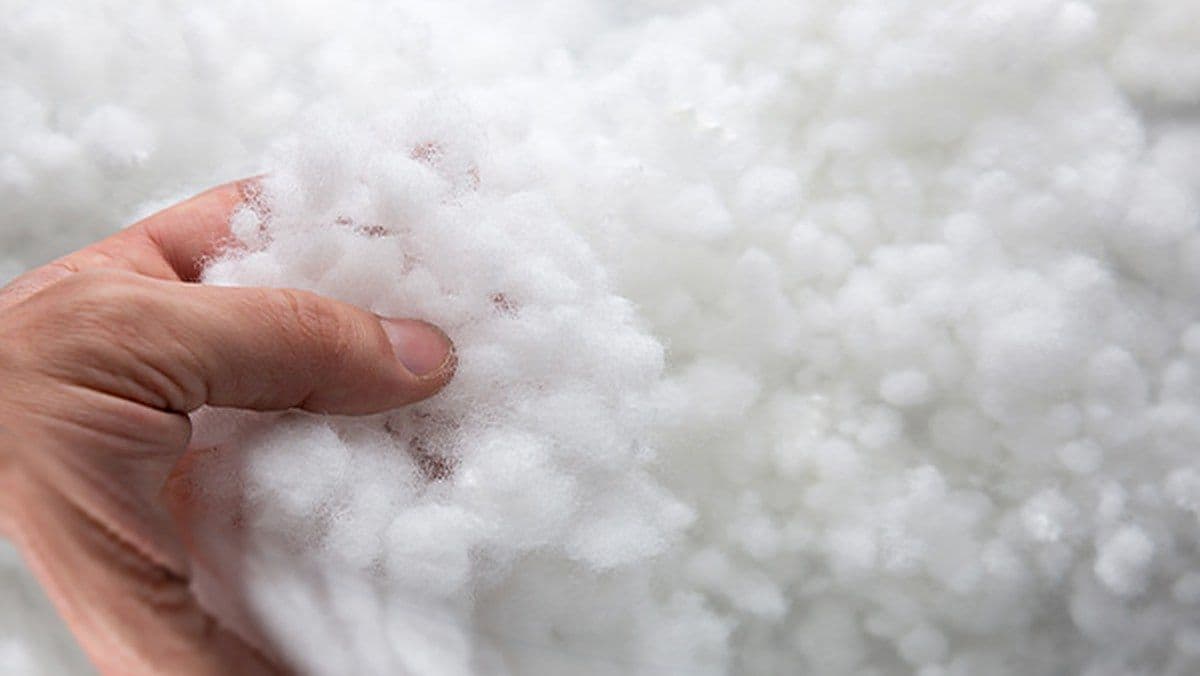
Ball fibre is a filling material made by working polyester filaments into small, rounded clusters. The name comes from exactly what you feel when you pick it up: independent soft balls, somewhere between a few millimetres and a centimetre across. The difference from straight fibre is not only visual. That structure decides how the filling behaves after it is compressed, how much air it holds, and whether it mats when washed.
How Ball Fibre Is Made
Production starts with straight polyester staple fibre. The filaments first pass through an opening line, where fibre compressed into bales is loosened and made uniform. From there it goes into the balling machine, where rotating drums and an air stream roll the filaments around themselves until they tangle into small spheres.
Three things decide how large and how firm the balls come out: the denier (fineness) of the filament, the cut length, and how long the fibre stays in the machine. A short cut at a low denier gives smaller, softer balls; a long cut at a high denier gives larger, springier ones. This is why two products sold under the same name can feel completely different in the hand.
What Is Silicone Ball Fibre?
In silicone ball fibre, the filaments are coated with a thin silicone layer before they are balled. The coating makes the filament surface slippery, so filaments slide over one another instead of sticking together and matting.
In practice this has three consequences:
- Recovery speeds up. A compressed filling returns to its previous volume faster and more completely once released.
- Matting drops. After washing, filaments are far less likely to lock together into hard clumps.
- The hand softens. The slippery surface makes the filling feel more fluid.
Uncoated ball fibre costs less and still gives good loft, but for products that will be washed and used for years the siliconised option lasts noticeably longer. We covered siliconising and the other fibre types in detail in What Is Fibre?.
Where Ball Fibre Is Used
The real advantage of ball fibre is that it fills three-dimensional volumes evenly. Because the clusters are independent, the filling takes the shape of whatever holds it and leaves no empty corners.
| Product | Why ball fibre |
|---|---|
| Pillows | High loft and fast recovery; the area under the head does not stay collapsed through the night |
| Cushions and decorative pillows | Fills a square form right into the corners without flattening inside the cover |
| Poufs and floor cushions | Fills a large volume with a light material and recovers its shape after being sat on |
| Toys and plush | Reaches small, irregular cavities without lumping along the seam |
| Sleeping bags and outerwear fill | Lightness and compressibility |
Duvets are the exception: there, siliconised straight fibre or hollow conjugated fibre is usually preferred, because a duvet needs the filling spread as a thin, even layer inside the quilting cells, while a ball structure works to build volume instead.
You can see the ball fibre types we produce on the Fibre page, and the finished products filled with it on the Pillows and Decorative Products pages.
Ball Fibre or Carded Fibre?
Both are polyester; what differs is how the filaments are arranged.
| Ball fibre | Carded fibre | |
|---|---|---|
| Structure | Independent small clusters | A continuous layer of parallel filaments |
| Loft | High, voluminous | Medium, denser |
| Recovery | Fast | Slow; flattens over time |
| Shaping | Takes the form of its container | Laid down as a sheet |
| Risk of shifting | Yes; needs a quilted or chambered cover | None |
| Cost | Higher | More economical |
| Suited to | Pillows, cushions, poufs, toys | Economy pillows, seat pads, sheet filling |
The one weak point of ball fibre is that it can gather to one side of a cover over time. A quilted cover or chambered stitching solves it, and for a pillow, plumping it regularly is enough.
What Sets the Price of Ball Fibre
There is no fixed price per kilogram. It moves with the polyester chip market and with the technical content of the order. The main factors are:
- Siliconising. Coated fibre costs more than uncoated.
- Denier and cut. Fine-denier (softer) fibre costs more than coarse.
- Raw material source. There is a clear gap between virgin and recycled polyester.
- Blend. Custom blends of different deniers are priced separately.
- Quantity and packaging. Bales, sacks or bulk shipment change the unit price on tonnage orders.
So a current price needs the type, denier and quantity to be known first. Send your requirement through the Contact page and we will settle the right fibre and the current price together.
Washing Products Filled With Ball Fibre
Among home textile fillings, ball fibre is the most washable group, siliconised ball fibre especially.
- Wash at 30-40 °C on a delicate cycle at a low spin speed.
- Use a small amount of liquid detergent rather than powder; powder residue collects between the balls and hardens.
- Skip the fabric softener: it coats the silicone layer and reduces recovery.
- Tumble dry on low with a few dryer balls, which tumble the filling and break up any clusters.
- Do not put it away before it is fully dry; trapped moisture is the main cause of odour and mildew.
For step-by-step instructions, see How to Wash a Pillow.
Frequently Asked Questions
Which is better, ball fibre or silicone fibre?
They are not opposing options. "Silicone" describes how the filaments are coated; "ball" describes how they are formed. Silicone ball fibre combines both, and gives the most durable result in products that get washed and compressed, like pillows.
How much ball fibre goes into a pillow?
In the pillows we produce, the fill runs between 650 and 1,500 grams. Near the lower end you get a soft, low pillow; near the upper end a firm, high one. Size and fill weight pairings are on the Size and Filling Guide page.
Does ball fibre cause allergies?
Polyester fibre is synthetic and does not hold moisture, so it does not create the damp environment dust mites need. On that count the risk of an allergic reaction is lower than with natural fillings.
Does ball fibre clump over time?
Good siliconised ball fibre will not clump for a long time if washed correctly. Clumping is mostly seen with uncoated or low-grade fibre, washing at high temperatures, and using fabric softener.
For ball fibre supply, custom blends or a filling service for your home textile brand or business, write to us through the Contact page.